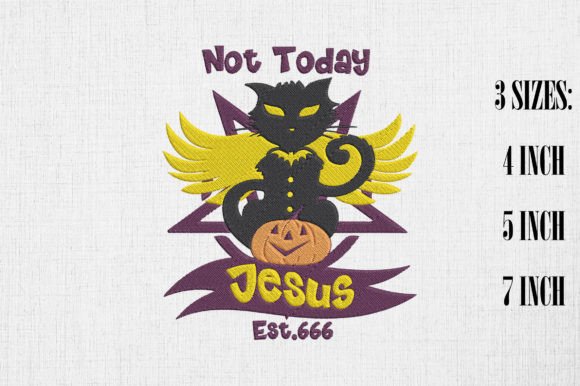
Black Cat Devil Not Today Jesus: Merch Review
As an embroidery designer who regularly consults with small businesses on merchandise production, I approach every new machine embroidery design with a critical eye toward commercial viability. When evaluating the "Black Cat Devil Not Today Jesus" design for business use, my first impression is that it strikes a unique balance between playful personality and bold statement. While categorized under Halloween, this design transcends seasonal decor to offer year-round appeal for niche brands. It possesses a rustic yet modern aesthetic that feels handmade and authentic rather than corporate or sterile. For a creative studio, pet brand, or alternative boutique, this visual personality signals to customers that the business has character. However, translating this intricate concept into small business merch requires careful technical consideration to ensure the final product maintains professional quality across various applications.
Commercial Applications for Branded Merchandise
In a real-world business scenario, versatility is key. I have reviewed this design specifically for its potential in custom apparel and branded accessories. For a local café or bakery with a quirky vibe, this design works exceptionally well as a back print on staff t-shirts or as a subtle accent on apron embroidery. The narrative element of the design creates a conversation starter, which is invaluable for customer engagement in service industries. Unlike generic logos, this artwork builds an emotional connection.
For Etsy sellers and handmade product creators, this design serves as excellent branding for packaging or thank-you cards when stitched onto fabric tags. As a tote bag design, it appeals to shoppers looking for reusable bags with personality rather than plain promotional items. I also see strong potential for embroidered patch production. Patches allow businesses to sell add-on merchandise without committing to full garment inventory. Customers can purchase the patch to customize their own denim jackets or bags, extending your brand identity beyond your direct product line. Furthermore, for pet grooming salons or veterinary clinics with a sense of humor, this design aligns perfectly with industry culture while remaining appropriate for a professional setting.
Technical Performance and Production Constraints
While the artistic merit is high, technical execution determines commercial success. When planning cap embroidery, caution is necessary. The vertical space on a cap front is limited, and complex designs with multiple elements can distort on curved surfaces. If using "Black Cat Devil Not Today Jesus" for headwear, I recommend testing a simplified version or resizing specifically for the cap frame to prevent registration issues.
Stitch density is another critical factor. This design likely contains detailed fills and text. On lightweight fabrics like summer dresses or scarves, high density can cause puckering or fabric damage. Conversely, on heavy canvas tote bags or denim aprons, insufficient density may cause the design to sink into the weave. You must match the fabric texture to the digitizing style. For dark uniforms, ensure the thread colors provide sufficient contrast; intricate details in black thread on a navy shirt will be invisible to the customer.
Small sizing presents the biggest risk for commercial embroidery. Text elements in this design must remain legible at reduced sizes. If you intend to use this as a small chest logo or sleeve detail, verify that the lettering height meets minimum stitch standards (typically 4mm-5mm for satin stitches). Tiny lettering often requires re-digitizing as running stitch or specialized micro-text to avoid thread breaks and illegibility. Always confirm the recommended hoop size before purchasing the digital embroidery file to ensure compatibility with your machine’s capabilities.
Impact on Brand Identity and Customer Trust
Merchandise is a tangible representation of your business standards. A poorly executed embroidery job damages trust faster than almost any other branding failure. When "Black Cat Devil Not Today Jesus" is produced correctly, it elevates the perceived value of your finished product. High-quality stitching signals attention to detail, suggesting that your core products or services receive the same level of care.
This specific design aids in buyer engagement by targeting a specific subculture. In the crowded marketplace of handmade product sales, niche specificity wins. Customers who resonate with the "Not Today" sentiment combined with the black cat imagery are likely to become loyal repeat buyers because they feel understood. Visual consistency across your merchandise line reinforces this. Using this design alongside complementary assets creates a cohesive collection rather than a disjointed assortment. Whether used on event merch for a Halloween pop-up or as a permanent fixture in your shop, the design acts as a filter, attracting your ideal demographic while repelling those who aren't a fit, which ultimately improves marketing efficiency.
Professional Designer Notes for Implementation
Before running production batches, adhere to these professional protocols to ensure the "Black Cat Devil Not Today Jesus" design performs reliably:
- Test in Black and White First: Before committing to full color, run a test stitch-out in single-color black or white. This reveals the underlying structure and highlights any registration gaps or density issues without wasting expensive variegated threads.
- Verify Small Patch Viability: Do not assume a standard design scales down perfectly for patches. Create a specific test at your intended patch size to check text clarity and border integrity.
- Review Thread Color Contrast: View your thread selection under both natural daylight and artificial shop lighting. Colors that look distinct on screen may blend together in physical thread, especially in low-light retail environments.
- Inspect Spacing and Kerning: Check the spacing between text and graphic elements. Tight spacing causes thread buildup and potential needle breaks, while excessive spacing looks unprofessional.
- Confirm Hoop Size Compatibility: Measure the actual stitch area against your available hoops. Ensure there is adequate clearance for the presser foot and that the design does not exceed the safe stitch field.
- Test on Real Fabric: Never rely solely on stabilizer tests. Stitch on the exact garment or material you plan to sell. A design that looks perfect on cotton twill may fail on stretchy jersey or textured linen.
- Use Proper Stabilizer: Match stabilizer weight to fabric and design density. Cut-away stabilizer is generally safer for wearable custom apparel, while tear-away may suffice for stable tote bags.
- Create a Printable Mockup: Before investing in thread and time, generate a printable mockup or digital visualization for client approval. This manages expectations regarding size and placement.
- Compare Beside Other Design Assets: Print or stitch samples of this design alongside your existing logo and branding. Ensure the style, weight, and color palette harmonize rather than clash.
- Confirm Commercial Licensing: Crucially, review the license terms included with the embroidery file. Verify that you have rights for commercial sale on finished goods, not just personal use. Documentation of this license protects your business legally.
The "Black Cat Devil Not Today Jesus" design offers significant potential for businesses seeking to inject personality into their merchandise strategy. By respecting technical limitations and prioritizing quality testing, small business owners can transform this digital asset into a profitable, brand-building product line that resonates deeply with their target audience. Always prioritize the integrity of the stitch-out over speed; in the world of branded embroidery, precision is the ultimate marker of professionalism.